
WORTHINGTON, W.VA.
How West Virginia Left a $40 Million Sewer Crisis to a Town of 170
Residents face a public health crisis from raw sewage while officials resist public hearings that could dissolve Worthington or put its failing sewer system under new management.
Reported Narrative
The Dinner
On Tuesday, Oct. 6, 2026, Worthington officials held a private dinner inside Town Hall. The town invited selected sewer customers from outside its corporate limits, but the gathering was closed to the public, and some council members did not know it was taking place. A resident served food while those present discussed grants, the engineering firm Thrasher and hiring a new water operator.
Two days later, reporter Esteban Fernandez wrote in the Times West Virginian that a "sense of optimism" had returned to Worthington. Fernandez reported that no votes or decisions were made at the dinner and that hiring the water operator still required town council approval.
Worthington's utility bills identified Oct. 7, the day after the dinner and the day before the newspaper report, as the date the town hired the operator. No public council vote approving the hire appears in the town's records.
On Oct. 16, a Freedom of Information Act request asked the town to identify the dinner's attendees, produce invitations and documents, and disclose records of any telephone vote to hire the operator, along with his employment contract. The request also sought communications between town officials and the county commission, Public Service Commission, Fernandez and resident organizer Andrea Zaleski. As of Oct. 26, the town had not responded, despite the five-working-day deadline under state law.
In the days before the dinner, sewer customers described worsening conditions. One woman wrote that her household had been unable to do laundry for weeks. Another reported that draining her washing machine caused her toilet to overflow. Several customers said they received 24-hour shutoff notices for utility bills delivered just two days earlier.
"If you or I dump something illegal we Goin to jail," one resident wrote.
The Times West Virginian described the complaints as "frustration on one of the town's social media pages over recent billing and service issues."
West Virginia has billions in drinking-water and wastewater infrastructure needs. In Worthington, one of the state's smallest communities, officials have violated residents' constitutional and statutory rights as they seek state intervention for sewer repairs the town cannot afford.
The Town
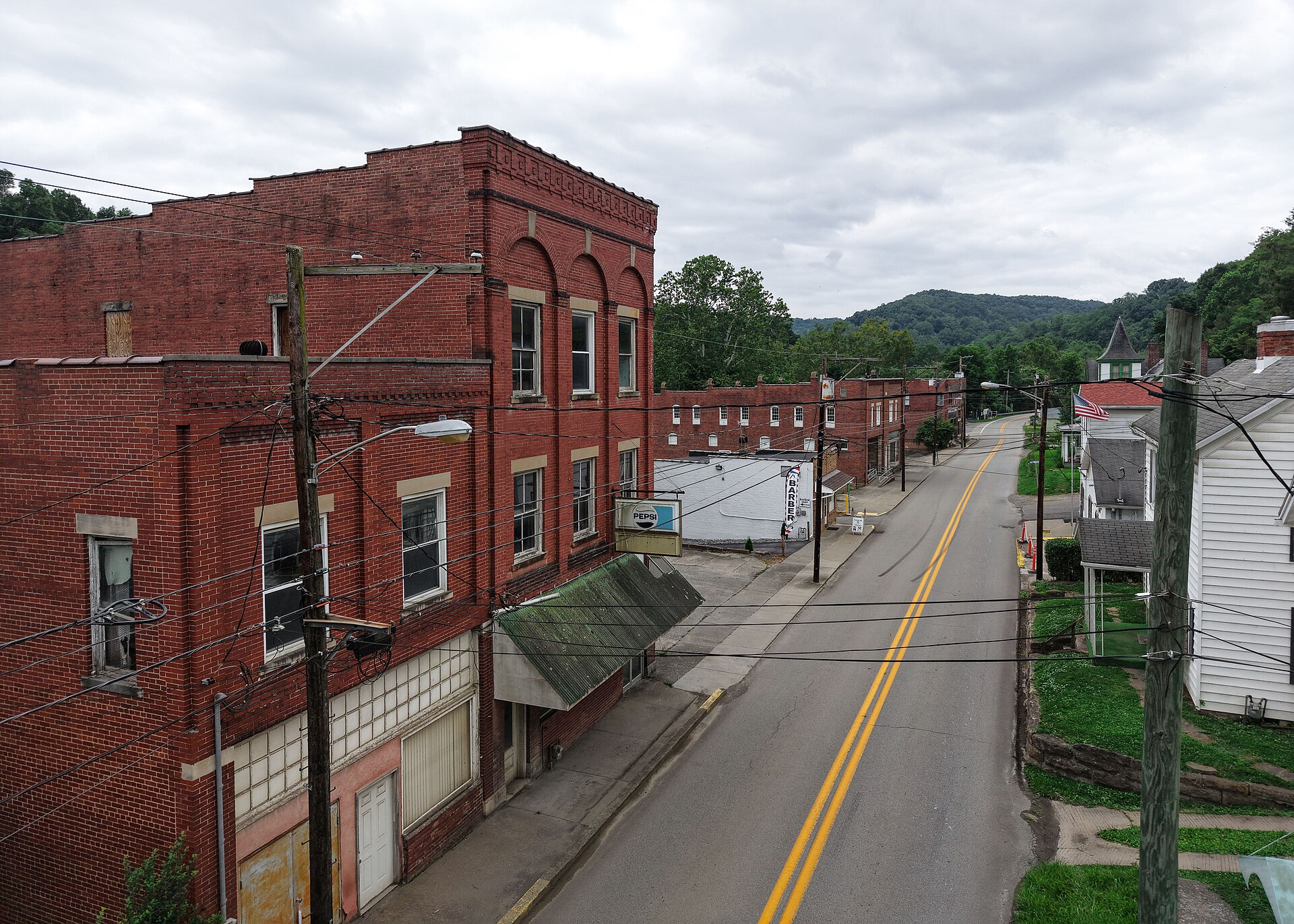
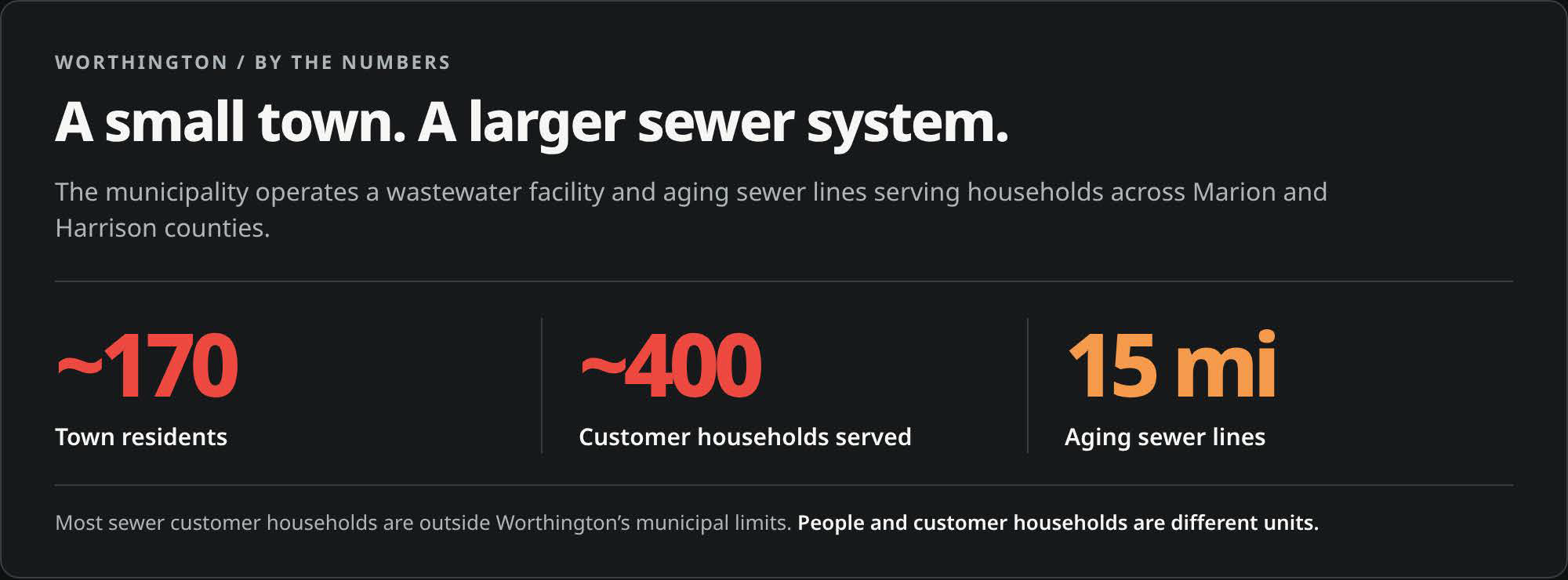
Worthington covers less than one square mile along the West Fork River, with roughly 170 residents. The town operates a wastewater treatment facility connected to 15 miles of aging vacuum sewer lines serving nearly 400 customer households across Marion and Harrison counties. Most of those households lie outside Worthington's corporate limits, leaving their occupants unable to vote for the officials governing their sewer utility.
Replacing the failing sewer system is estimated to cost between $20 million and $40 million. State environmental inspectors documented 58 permit exceedances, fecal coliform discharges nearly 12,000 percent over legal limits, and a collection drum with holes drilled in it to drain wastewater directly onto the ground.
The West Virginia Department of Environmental Protection calculated a base penalty of $77,200, then reduced it by 70.8 percent after reviewing Worthington's finances and determining the town could not afford to pay.
Worthington's June 2025 municipal election produced just eight certified legal votes. Under West Virginia Code § 8-35-1, when fewer than 20 legal votes are cast in a municipal election, the county commission, upon proper proof, shall declare the charter forfeited and the municipal corporation dissolved.
By that fall, council members Melvin Lindsey, his wife Janet Lindsey and Trudy Cain had resigned, leaving Worthington without enough council members to conduct business or pay bills. Circuit Judge Patrick N. Wilson issued a mandamus order compelling the three officials back into office.
Cain had filed a written plea stating that harassment threatened her employment and safety. Melvin Lindsey told the court that he and Janet had moved to Morgantown, outside Worthington and Marion County. The West Virginia Constitution restricts municipal office to citizens entitled to vote in the municipality, and state law requires council members to live in the town they govern. Wilson ordered the Lindseys back into office without addressing their residency.
Cain also wrote that Lindsey told her he, Janet Lindsey and Mike Basnett had voted privately by telephone to hire a town clerk and deny then-Mayor Deborah Heflin's request for meeting security.
Heflin later placed distressed-utility petitions on council agendas, while Lindsey raised municipal dissolution. During one council debate, Janet Lindsey abstained from voting, stating on the record, "I do not live in that town." She later warned, "Well, if we don't have money to keep things running, we're going to have to do something." Council members repeatedly walked out before votes could take place.
Heflin resigned July 31, 2026. The council immediately appointed Melvin Lindsey interim mayor, despite his previously disclosed residence outside Worthington.
Five days later, Heflin filed two petitions as a registered town voter and sewer customer. One asked the Marion County Commission to forfeit Worthington's charter based on the eight-vote election. The other asked the PSC to determine whether the sewer system was a distressed utility.
Municipal dissolution would transfer the town's assets and liabilities to the West Virginia State Auditor as special receiver.
"The Auditor is going to find what I found, which is that the fix was bigger than the town," Heflin said. "Somebody is finally going to have to say out loud what this costs and who pays for it."
The County
The Marion County Commission acknowledged Heflin's dissolution petition at their August 12, 2026, meeting. Upon receipt of a lawfully filed petition, the commission will either set a hearing date or table defective petitions. For Heflin's filing, County Administrator Kris Cinalli announced that no action would be taken that day.
Earlier in the same meeting, engineer Kevin Watkins of The Thrasher Group had described neighboring Farmington's aging water system, which was losing more than half its water despite $3.5 million in grants and loans. Watkins said federal infrastructure money had largely expired and new grants were increasingly difficult to secure.
Commission President Linda Longstreth stated, "All these small towns are having problems."
Later that morning, resident organizer Andrea Zaleski asked how sewer customers outside Worthington could establish their own utility district. County Attorney Charles Shields and Commissioner Ernie VanGilder said the pending petition placed commissioners in the position of judges who could not advise residents or take sides before a hearing.
Seconds later, Cinalli invited Zaleski to email him her questions and offered assistance. Commissioner Bobby DeVaul instructed her to copy Shields.
The West Virginia Supreme Court of Appeals had unanimously reversed the same county commission in 2021 for exceeding its statutory authority in a proceeding involving an estate executor. In Dye v. County Commission of Marion County, Shields represented the county and argued that a formal hearing was not always necessary for due process. The Supreme Court found that the commission had exceeded its authority and compromised its required neutrality.
Secretary of State General Counsel David Cook subsequently advised the commission to hold a public hearing on Heflin's petition, receive evidence and issue a written order.
Cinalli privately emailed Lindsey that the county had no timeline for a hearing, praised the town for moving in the right direction and invited further discussions about Worthington's future.
When public-records requests sought communications between county officials, Lindsey and the press concerning Worthington, Shields withheld the requested records. He argued that communications involving Zaleski or the state utility board did not meet the statutory definition of public records concerning the public's business.
In October, Zaleski appeared before the commissioners on Lindsey's behalf while he attended a church event. She requested county assistance to pay town contractor invoices and purchase accounting software, acknowledging that the sewer department had experienced "a terrible two weeks."
Longstreth replied from the bench: "Thank you. I hear that you're doing much, much better out there and trying to pour everything together. And we will. We will. I have faith in that."
The County Commission subsequently placed an item on its agenda recording $4,620.17 in invoices paid on behalf of the Town of Worthington.
The State
Under West Virginia Code, the Public Service Commission is to hold public and evidentiary hearings within 25 miles of the affected service area upon the filing of a distressed-utility petition.
The hearings would provide a forum for Worthington's sewer customers to testify and regulators to examine whether another utility should assume operations.
PSC staff recommended dismissing Heflin's petition without a hearing. Analyst Lisa Bailey cited Worthington's corrective-action plan and reported that the Utilities Division had found no significant financial problems.
The DEP had already determined in its 2024 enforcement order that Worthington could not afford its environmental penalty. In summarizing the town's plan, Bailey omitted its statement that initial resources were exhausted.
The Thrasher Group outlined four phases of sewer replacement, each costing roughly $6 million to $8 million. The overall estimate of $20 million to $40 million amounts to approximately $50,000 to $100,000 per customer household.
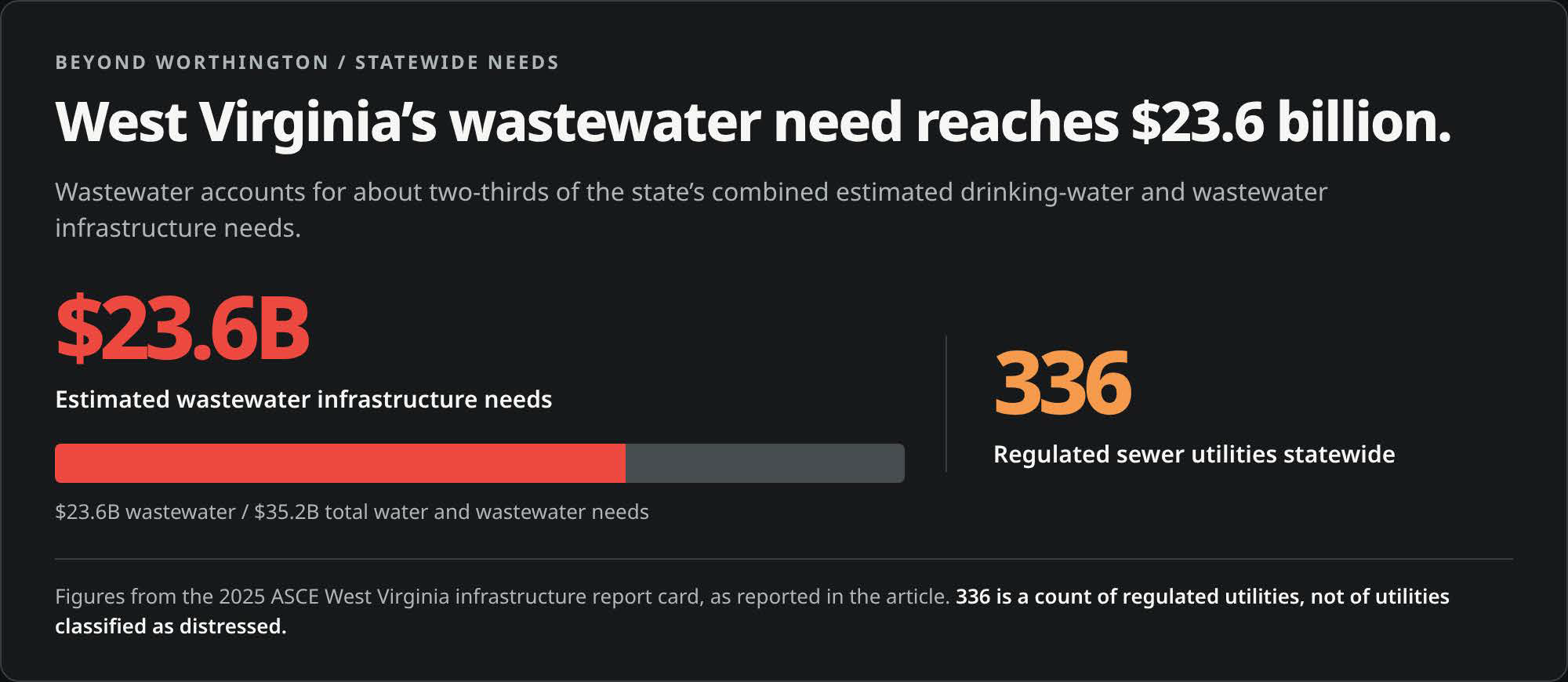
In its 2025 infrastructure report card, the American Society of Civil Engineers estimated West Virginia needed $35.2 billion for drinking-water and wastewater infrastructure, including $23.6 billion for wastewater across 336 regulated sewer utilities.
Acting Mayor Lindsey had also told staff at the PSC that Worthington had no new or unresolved customer complaints, even as customers were publicly reporting sewage backups, unusable household fixtures, shut-off notices and repeated requests for repairs.
In a subsequent memorandum, PSC staff attorney Brendan Doneghy reiterated his recommendation to dismiss the petition, calling further proceedings "a redundant waste of resources."
"Worthington's system didn't change in five days; Ms. Heflin's office did," Doneghy wrote.
In 2025, the PSC held full public and evidentiary hearings after one customer in a 27-home subdivision of Hubbard Heights filed a petition under the same law. In Worthington, staff recommended dismissal without those hearings for a sewer system serving nearly 400 households. The Lindsey administration supports dismissal.
Heflin challenged staff's recommendation in reply filings, arguing that the town's corrective-action plan could not replace the hearings required by the distressed-utility law.
The Times West Virginian subsequently published another article by Fernandez under the headline "Former mayor's plan to dissolve Worthington falls short." The article suggested the county's dissolution proceeding "may be stillborn" because PSC staff opposed the separate distressed-utility petition.
Fernandez quoted Cinalli suggesting the county should give Worthington more time because the PSC saw progress. The article omitted earlier guidance from the Secretary of State's office advising the county to hold a hearing and issue a written order.
The Bill
In September 2026, Lindsey's administration placed annexation under new business on Worthington's council agenda while the county still had not heard the petition to dissolve Worthington. Expanding the town's boundaries would also expand its tax base and potential electorate.
Under § 8-35-1, charter forfeiture depends on the number of legal votes cast at a municipality's "last election." Worthington's next regular municipal election is scheduled for June 2027. If the county delays its decision beyond that election, the town could argue that the new vote supersedes the eight-vote result from 2025. Annexation could enlarge the electorate before that vote.
C. Renee Courtney, who lives outside of Worthington's corporate limits, submitted a formal notice to the circuit court challenging the Lindseys' constitutional eligibility to govern from Morgantown.
Judge Patrick Wilson subsequently found that the mandamus proceeding appeared moot because the council had made new appointments and the Lindseys had decided to remain in office. He directed the town to submit a final dismissal order within 10 days without deciding the residency challenge.
Days later, Worthington canceled its scheduled council meeting. The town's website announced a new date and reminded prospective council applicants that they must meet state residency requirements. Melvin Lindsey continues serving as mayor while residing in Monongalia County.
In September, a Worthington sewer customer reported that he had already paid $121 toward an August sewer bill when Worthington sent him another notice demanding $130 within 24 hours to avoid disconnection. Raw sewage had been flowing into his yard for a month, he said, despite repeated requests for repairs.
"Maybe before you threaten to shut my sewage off," he wrote, "make sure [sewage] isn't flowing out into my yard like it has been for a month."
On Oct. 6, Worthington had welcomed selected guests to a private dinner inside Town Hall. Some council members did not know about it, and the public could not attend. Officials discussed grants, engineering and a new water operator.
Melvin Lindsey said the evening "harkened back to how the town used to do things."
Disclosure: Seth Sturm is an elected member of the West Virginia State Democratic Executive Committee and founder of Democratic Justice. He provided unpaid civic, regulatory and strategic advice to former Mayor Deborah Heflin and resident organizer Andrea Zaleski concerning Worthington's municipal and utility remedies. He does not represent or speak for the town of Worthington.