
OPINION
They read what Michael Bowman said about 18-year-olds. They backed him anyway.
People in positions of trust vouched for Michael Bowman as a journalist and bear some responsibility for the trail of wreckage he left across West Virginia.
Reported Narrative
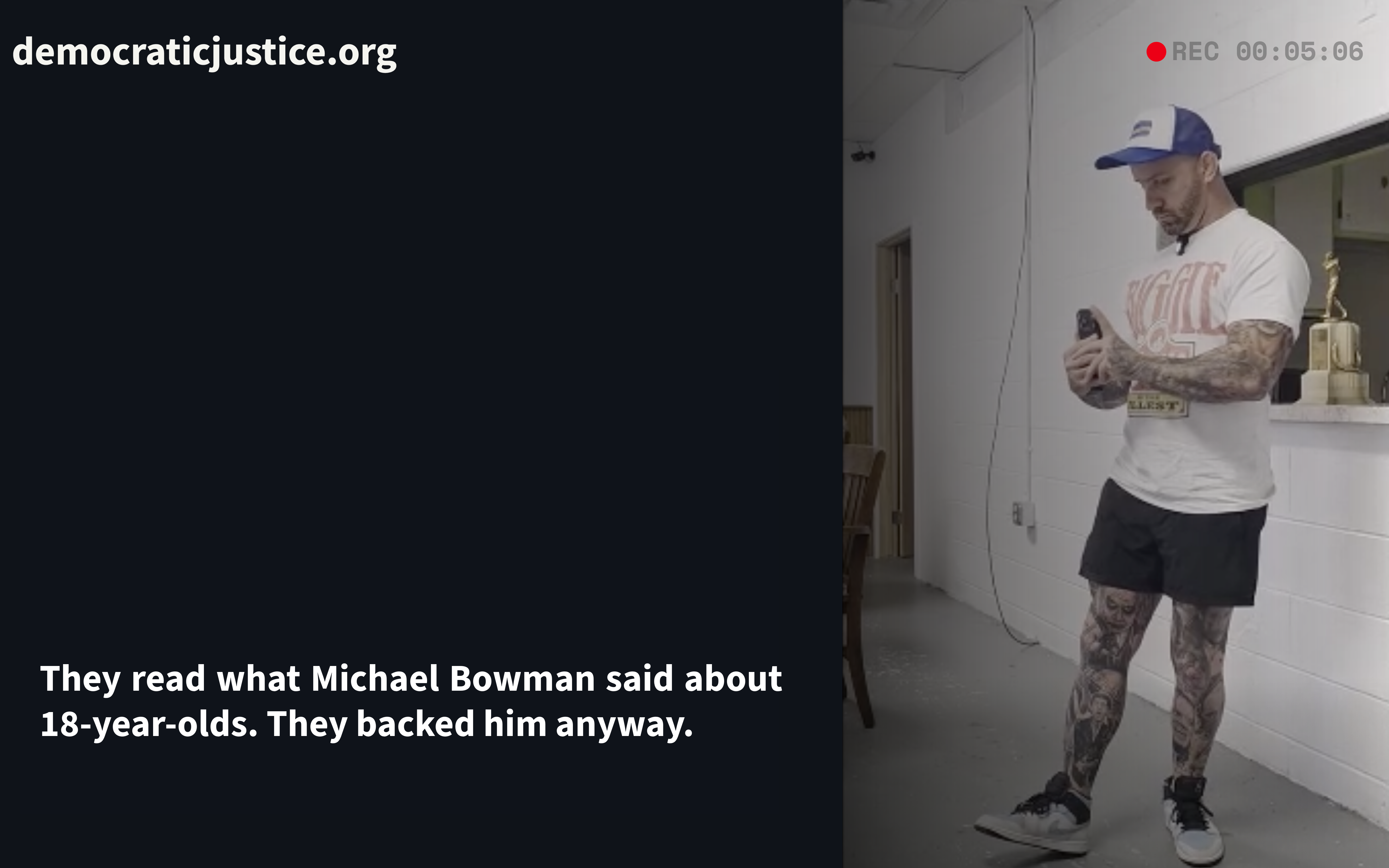
Michael Bowman built a following across West Virginia calling himself an independent journalist, and that title opened doors. Podcaster J.D. Belcher, congressional nominee Ace Parsi, and attorney Stephen New treated him as a legitimate investigator.
Months before police arrested Bowman on Sept. 30 on felony charges, Belcher and Parsi received direct documentation of his recorded statements defending men on the age of consent. Both kept promoting him, while New enabled him through the courts.
Endorsements from trusted voices gave an unvetted outsider immediate credibility in communities where residents had never seen his past videos. Bowman used that cover to enter small towns like Worthington, where he flattened an eight-figure infrastructure crisis into a personal feud against two local women.
Following Bowman's felony arrest, the figures who built his credibility scrambled to distance themselves while demanding silence from the community.
Every gatekeeper who promoted and legitimized Bowman, or reasonably should have known what they were promoting, shares culpability for the harm he spread across this state. They held the platforms to protect the vulnerable, and they chose to protect an influencer instead.
The Safety Test
In the weeks before he pivoted to political content, he posted videos about women and the age of consent. In 2025, Bowman published a video addressing statutory age of consent laws. In it he said:
"The problem with performative virtue is that it always needs a villain, and lately one of the easiest targets I've seen in my comment sections, is anyone who toes the legal line of the age of consent. This is where we twist conversations about power and protection, into something murky, something more about control, and less about care."
He acknowledged that eighteen-year-olds often lack the capacity "to handle power, consent, or adult decisions." Then he moved the line himself.
"But here's what I don't respect: when people say they believe in the line, but move it the second they feel uncomfortable. 'Yeah they're 18, but that's only technically legal. They just turned 18, they're still a baby, and not emotionally ready.' But which is it? Is 18 the line, or not?"
Bowman framed female friendship as an act of theft, calling it "a quiet humiliation wearing the mask of companionship" where a woman can "reject you romantically, and still have full access to you." He treated a woman's boundaries as an act of emasculation, asking male viewers, "You want your power back?"
In his commentary on modern dating, he declared that "the bad, manipulative women in our society are not talked about enough." Framing relationships as zero-sum power struggles where men must reclaim dominance over women establishes the blueprint for abuse.
Publicly defending adult relationships with eighteen-year-olds on technical legal grounds provides immediate notice of predatory behavior. His dating advice taught men that female friendship is a trap and that extracting power over women represents the primary masculine goal. That is an ideology of subjugation.
His words were public months before his arrest. After his arrest, his social media platforms were deactivated on Sept. 30, WDTV reported.
Bowman's anti-woman rhetoric should have been an absolute red line. People approached by an outside creator deserve to know the risks associated with his presence. Instead, anyone who searched for Bowman would have found prominent community members defending him as a legitimate independent journalist.
The Podcaster's Contradiction
J.D. Belcher, host of the regional podcast Creepalachia, acted as an early catalyst for Bowman's reach by hosting him for a three-and-a-half-hour promotional interview on Episode 145. Belcher told his audience that he enjoyed the stories Bowman told.
When presented with Bowman's recorded statements defending men on the age of consent and attacking modern women, Belcher excused his inaction through direct contradiction:
"He answered for what I found concerning during a 3 hour podcast. I do not know what is being told here and I don't have the time to investigate it."
I warned Belcher directly on that thread about the precedent he was setting and how I viewed his inaction. I wrote, "You are revealing yourself to be the type of man who is unwilling to call out other men for toxic behavior."
On Sept. 30, following Bowman's felony arrest, Belcher published a statement on Facebook:
"One reason there is a culture of victim shaming is that people are too afraid to disconnect and call out their friends. That's not here. Not ever."
Belcher went on to declare Creepalachia "a victim's first platform," yet kept his collaborative episodes published online to collect ongoing ad revenue and downloads.
Now, Belcher posts on Facebook declaring it "disgusting" that people message him defending adults dating sixteen-year-olds. But that is the exact audience Belcher cultivated.
When directly confronted on social media with Bowman's statements defending men who toe the age-of-consent line, Belcher dismissed the warning as "wrong," said only "3 people cares," and framed Bowman as an "innovator" being targeted by "haters."
Belcher spent months ignoring blatant misogyny and platforming a man who parsed statutory consent lines. Now, he is shocked when that exact audience uses that exact rhetoric with him.
The media's failure to vet Bowman increased his reach, legitimized his bona fides as an independent investigative journalist, and enabled him to build a broad network of institutional support.
The Candidate's Contradiction
The second failure occurred in a political context and involved a candidate whose career centered on media literacy.
Before running for Congress, Ace Parsi served as the Director of Coalition Engagement at iCivics, the national civic education organization founded by Supreme Court Justice Sandra Day O'Connor.
Parsi led the CivxNow coalition and served as Senior Director of Outreach and Partnerships for Educating for American Democracy. He built a career around teaching citizens critical thinking, democratic norms, and how to evaluate digital media.
Despite this impressive background, Parsi, the Democratic nominee for Congress in the 2nd District, actively dismissed concerns over Bowman's unethical journalism and past comments about women and girls.
In July, I warned Parsi via text message that Bowman's recorded defense of statutory boundaries was disqualifying. Parsi categorized the objection as an "emotional litmus test" that conflicted with his political battles.
Parsi explained his rationale by saying he placed himself in front of anyone holding a microphone because his campaign lacked corporate funding and needed access to every available audience.
Parsi stated that Bowman operated outside his team, and they didn't coordinate.
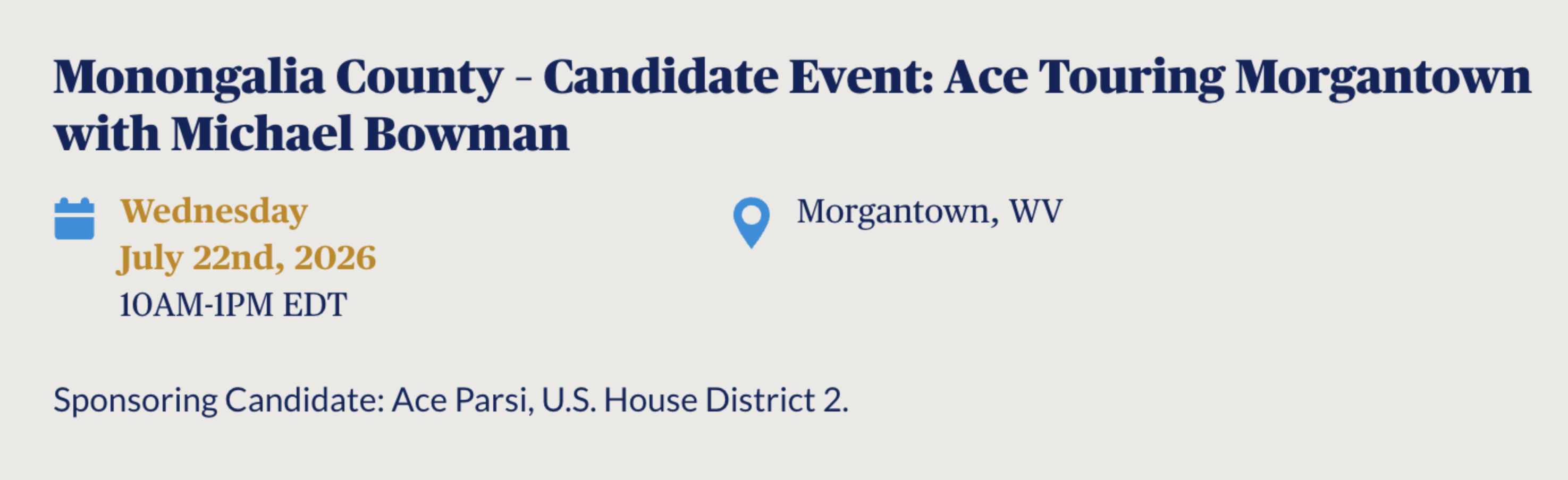
That same day, a public event titled "Monongalia County - Candidate Event: Ace Touring Morgantown with Michael Bowman" appeared on the State Democratic Party calendar, sponsored by Parsi's campaign.
When presented with the official flyer alongside Bowman's exact age-of-consent quotes, Parsi retreated to procedural denial and blocked me.
A national director of civics education who taught media literacy for a living looked at documented evidence of unethical journalism and anti-woman ideology and chose an influencer's follower count over community safety.
Political validation shielded Bowman from public scrutiny, allowing his operation to escalate from online rhetoric to federal litigation against private citizens.
The Lawyer's Contradiction
The third failure occurred in the legal system and involved a civil rights attorney who turned federal civil rights statutes against a private citizen.
Worthington needed between $20 million and $30 million to fix its failing sewer system. The Marion County town of fewer than 100 houses faces a wastewater infrastructure collapse that local tax revenue cannot solve.
Towns across West Virginia share that exact crisis. The state's own needs assessment identifies statewide water and sewer needs between $16 billion and $20 billion, while the legislature set aside $145 million.
Bowman arrived in town and turned this story of systemic collapse playing out in a local town into a narrative of local corruption, focusing on the two women in town he disliked: then-Mayor Debbie Heflin and Renee Courtney, a private citizen who attended council meetings and published updates on a community Facebook page.
On April 15, 2026, Bowman cursed at the mayor in Worthington town hall and accused her of having "cronies," including Courtney. Bowman's behavior continued escalating, and the mayor eventually called the police.
When deputies arrested him for obstruction, charges prosecutors later dismissed, Bowman partnered with attorney Stephen P. New to file a federal civil rights lawsuit against the town, Mayor Heflin, and Marion County.
Bowman also sued Renee Courtney under provisions of 42 U.S.C. § 1983, the Ku Klux Klan Act of 1871, passed by Congress to protect citizens from state-sanctioned abuses under color of law.
Bowman, through New, alleged "upon information and belief" that Courtney acted "under color of state law" in a conspiracy with the mayor, asserting that her social media posts were planned in coordination with town officials to defame Bowman.
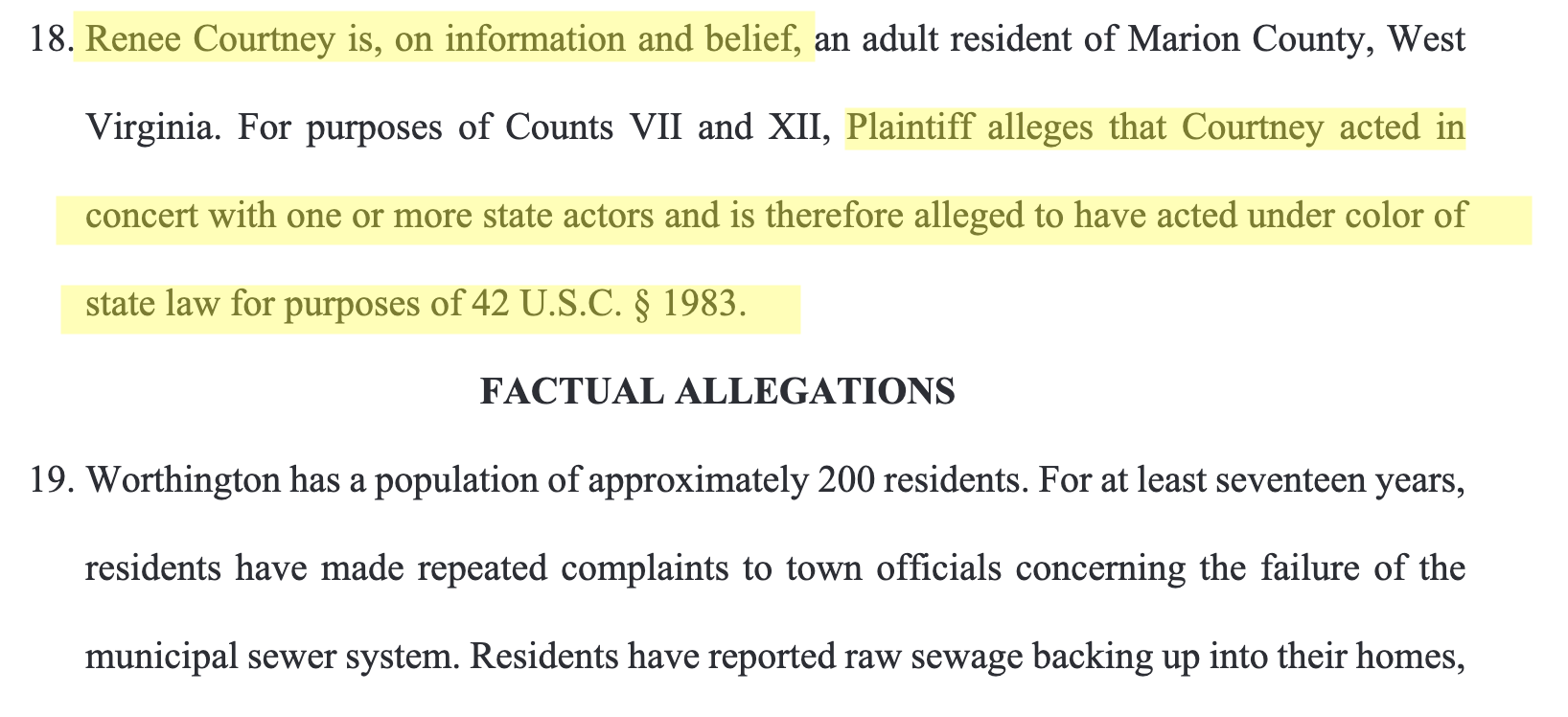
An attorney who files a federal complaint certifies under Rule 11 of the Federal Rules of Civil Procedure that he has conducted a reasonable inquiry into the facts and that the factual contentions have evidentiary support. The complaint does not quote one false statement she made.
When Courtney challenged the lawsuit in a motion to dismiss, New revealed what he considered evidence of a conspiracy: an AI-generated booking photograph.
New argued that a private citizen does not ordinarily possess an arrestee's photo and claimed the image proved a link between Courtney and the police department. Again, the image was AI-generated. It doesn't match the official booking photo.
New has never explained what inquiry led him to conclude that Renee Courtney conspired with the government of Worthington, because the record contains no such evidence.
While the federal lawsuit was active, Bowman published an hour-long video attacking the town, leveling accusations against Heflin and Courtney to his followers. New offered zero public advice to de-escalate. He permitted his client to monetize and broadcast public attacks against the very citizens he was suing in federal court.
After Bowman's Sept. 30 arraignment on felony charges, New's approach to social media reversed entirely. Standing before television cameras in the courthouse hallway, New confirmed that Bowman deactivated his platforms on legal advice to avoid the impending "social media circus."
New was silent while Bowman's platform attacked the women he was suing throughout the summer, then advised deactivation the moment felony charges landed.
Following Bowman's time in Worthington, I stepped in to help. I have spoken to and advised all sides. It is my work with Mayor Heflin to pursue the town's statutory remedies that has emerged as the central effort, which continues to this day.
Legal representation converted an online agitator into a serious federal plaintiff, leading established institutions to buy into his brand.
Institutional Laundering
The fourth failure is broad and encompasses the institutions that accepted Bowman's manufactured image without scrutiny.
One such example occurred in higher education, where academic gatekeepers accepted Bowman's self-appointed credentials and prepared to whitewash months of community harm as modern journalism.
An event titled "Fireside Chat with Journalist Michael Bowman" was scheduled in the Encova Auditorium at Marshall University's Brad D. Smith Center for Business and Innovation for October 13.
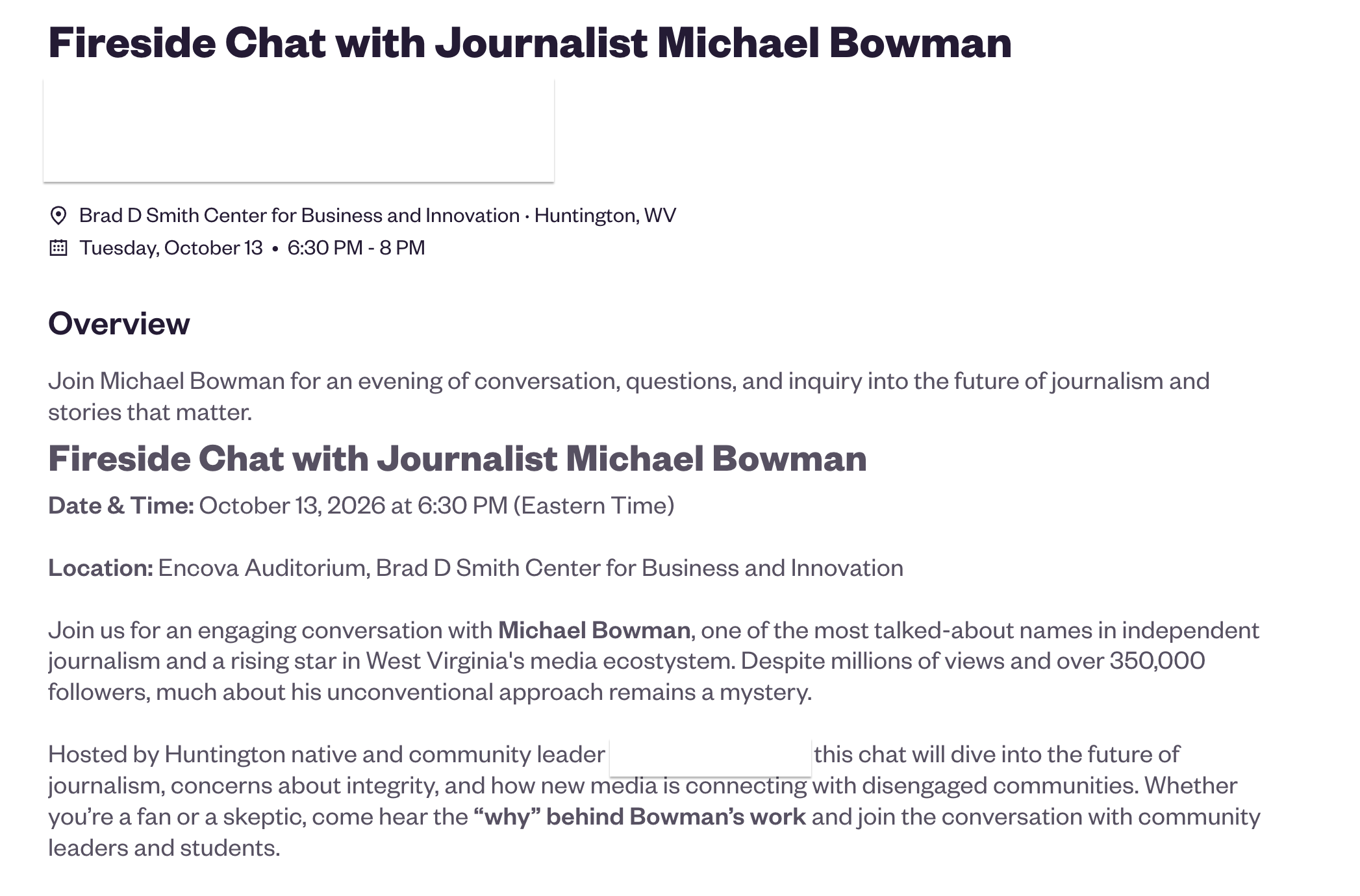
Marketing materials described him as "a rising star" with "over 350,000 followers," inviting students and community members to explore "the future of journalism" and asserting that "much about his unconventional approach remains a mystery."
Bowman's public timeline already contained recorded statements defending men regarding the age of consent. Contained footage documented him cursing at local officials. Contained his legal filings targeting local women.
The university apparatus framed community harm as media innovation and offered an academic stage to a dangerous man. The listing was canceled Sept. 22 without public explanation.
Even after law enforcement arrested Bowman on felony strangulation charges, WCHS called him an "online journalist," and MetroNews called him a "well known on-line journalist." The label spread from there through syndication and aggregators. The press validated his self-appointed title to the end.
All of these failures involved people and institutions that could have amplified the warning instead of the man.
The Women Who Saw It
Following Bowman's arrest, people, mostly women, who had followed his content began contacting me.
One had followed him since February without suspecting anything was wrong. She said that she would have unfollowed immediately if she had seen the videos I shared.
Another had defended him as a freelance journalist because she never saw his early catalog. "If I had," she wrote, "I would have listened AND I would have warned my friends."
A domestic violence survivor said my early posts helped when a friend had her own run-in with Bowman. They saw the warning, and they acted on it.
The people with the platforms didn't give it to them. Belcher had the audience. Parsi had the campaign. New had the courts. If they had exposed Bowman instead of promoting him, how many people who crossed his path would have known what they were dealing with?
That's the duty they owe now. They can't undo what Bowman did. They can help clean up in the aftermath.
Start with the one thing everyone should be able to agree on. Renee Courtney is a private citizen being sued in federal court over a meme. The complaint doesn't quote a single false statement she made. New filed it under the Ku Klux Klan Act. It's still active. She enters the holidays with her savings and reputation on the line.
Bowman can dismiss it. New can advise him to. Everyone who vouched for Bowman can say publicly that it needs to end.
Drop the lawsuit against Renee Courtney. Then we can start talking about the rest.
If you or someone you know is experiencing domestic violence, the National Domestic Violence Hotline provides free, confidential support 24/7 at 1-800-799-7233 or by texting START to 88788. The West Virginia Coalition Against Domestic Violence lists regional programs at wvcadv.org/partners.
Seth Sturm is an elected member of the West Virginia State Democratic Executive Committee, Senatorial District 2, and the founder of Democratic Justice. He writes in his individual capacity.