
EXLCUSIVE
The House with the Broken Lock
A leaked recording reveals how national Democratic officials dismantled the Black political machine in Alabama, leaving the state vulnerable to Republican redistricting efforts that target Black voting power.
Reported Narrative
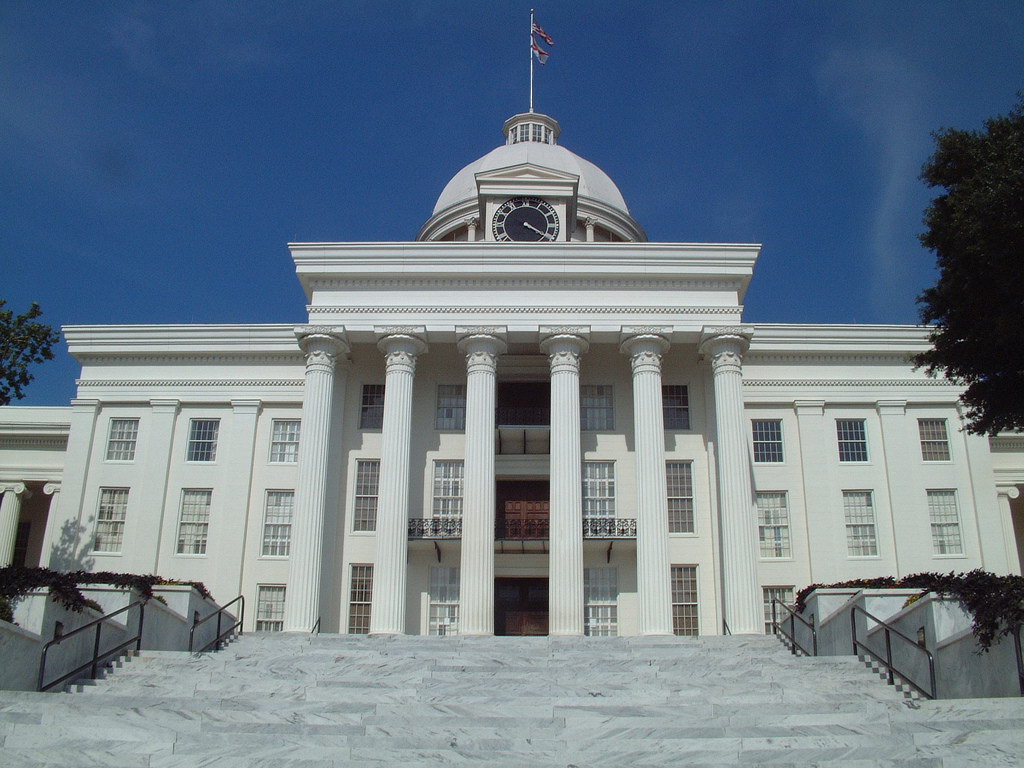
MONTGOMERY, Ala. — Alabama Republicans moved this week to let Gov. Kay Ivey call new U.S. House primaries under a court-approved map that would weaken Black voting power before November, even as voters have already cast ballots in the state's May 19 primary.
After the Supreme Court’s decision in Louisiana v. Callais, Alabama lawmakers opened a special session on legislation that could force replacement congressional primaries if courts allow the state to revive blocked maps. The immediate fight threatens Shomari Figures’s 2nd District. The larger Republican project reaches toward a 7-0 congressional map, with Terri Sewell’s 7th District also in jeopardy.
HB1 would allow Alabama to replace primaries already underway with new contests under revised districts.
Democrats answered from Birmingham. At Boutwell Auditorium, Sen. Cory Booker, Rep. Terri Sewell, former Sen. Doug Jones and Birmingham Mayor Randall Woodfin spoke about voting rights and representation. The stage gave national Democrats a public response to the map fight. It also put Jones back inside a story that began years earlier, when Jones initiated a challenge to the DNC that led to 8 years of DNC interventions in the state.
A newly surfaced September 2021 recording from West Virginia recontextualizes those interventions.
On the video, Rules and Bylaws Committee member, Harold Ickes, describes how the Democratic National Committee found a jurisdictional hook to break the Black caucus controlled by Civil Rights leader, Joe L. Reed. Ickes served as Bill Clinton’s deputy chief of staff in the 90s, and has sat on the DNC Rules and Bylaws Committee off and on for decades. He told the West Virginia meeting that Tom Perez had asked him to “try to deal with the challenge” in Alabama.
Alabama's rules, the national party said, lacked a valid affirmative action and outreach plan for Hispanic, Asian American, Pacific Islander, youth, LGBTQ and disabled Democrats. The DNC invalidated the 2018 leadership elections of Nancy Worley and Randy Kelley and ordered Alabama to freeze further minority at-large selections until the party rewrote its bylaws and adopted outreach programs.
"There was a very dynamic well-ensconced black caucus of the Alabama party and it had a lock on who got nominated," Ickes said. "It was run by a well-known very active black person by the name of Joe Reed."
Reed chaired the Alabama Democratic Conference, the state's principal Black Democratic organization, and served as the Alabama Democratic Party's vice chair for minority affairs. Under a 1990 consent decree, that position let Reed personally appoint more than 30 at-large members to the State Democratic Executive Committee, giving his bloc control over internal party votes.
On the recording, Ickes praised Reed's civil rights history. He said Reed fought in Alabama when there were no federal marshals, no Justice Department, no national press watching, and when people who challenged power could "end up swinging from a tree."
Then he pivoted. The structure Reed built, Ickes said, had "morphed" into autocratic control of the Alabama State Committee.
Reed controlled the caucus "lock stock and barrel," Ickes said. Younger Black legislators and activists could not get into Reed's circle.
"So breaking that lock that Reed and his caucus had was a major effort of the reforming of the rules," Ickes said.
Ickes claimed success. "That was a massive fight, which we won — which the Alabama reformers won," he said.
Despite Ickes’s claimed victory, Reed's faction returned to power in 2022 when Randy Kelley, Reed's endorsed candidate, became state party chair. In May 2023, Kelley and Reed used state party control to unwind the DNC's caucus structure.
The DNC treated the 2023 bylaws vote as a new compliance crisis. Its hearing officer found that dozens of at-large members arrived at the May meeting and could not receive credentials unless they paid a $50 fee. The report found no clear deadline, no specific bylaw warning members that payment had to occur before the meeting and no recourse for members who tried to pay at the door. The report also found that the margin for the bylaws was “clearly correlative” to the number of members denied credentials.
The national party then moved again. The DNC ordered Alabama to restore the caucus structure Reed’s faction had unwound and return to national compliance. The fight had now run in both directions. The DNC had first used diversity rules to break Reed’s lock. Reed’s faction then used state-party rules to undo the DNC’s structure. The DNC answered by treating that move as another violation.
Reed had already said what the conflict had become. After Kelley’s 2022 election, Reed told Alabama Political Reporter, “I play by the rules, but I learn the rules, now. And if I’m in it, I’m going to have something to say.”
In 2021, Ickes told WV Democrats his view on the rules: "What you need to come up with is not too many details," Ickes said "You can be hoisted on your own petard when it comes to details." Opponents, he said, can "use the rules that you come up with to jam you."
Furthering accusations of factional warfare from within the DNC, Ickes named internal opponents in West Virginia at the 2021 meeting. "Seth and his sister and others" were "very difficult," he said, saying that he had advised “God knows how many times” that “at bottom you gotta outvote."
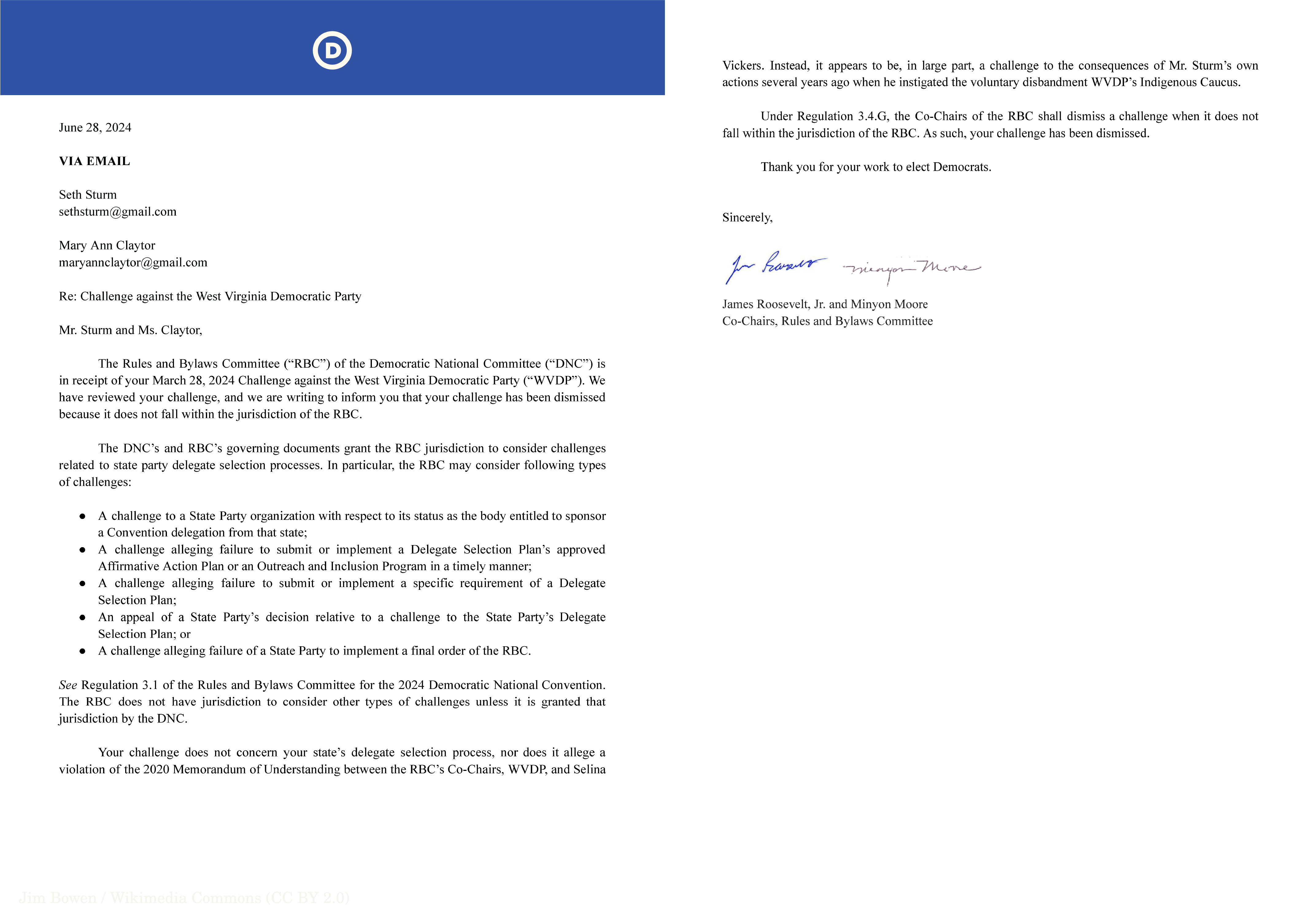
When challengers inside West Virginia later petitioned the DNC's Rules and Bylaws Committee for a hearing, they were denied.
On June 28, 2024, RBC co-chairs James Roosevelt Jr. and Minyon Moore dismissed the challenge filed by Seth Sturm and Mary Ann Claytor. The letter said the challenge did "not fall within the jurisdiction of the RBC."
The sign-off read, "Thank you for your work to elect Democrats."
In 2025, in Minneapolis, Joe M. Reed, Joe L. Reed’s son, stood before the full DNC. The Credentials Committee had spent two hours questioning Alabama. Raymond Buckley, the New Hampshire state chair, called Alabama “the one party that just keeps on coming back.” Lorraine Miller said the thought that Alabama Democrats “cannot have faith that this party can run an election” broke her heart.
The politics being played, Reed said, were “offensive to people in Alabama.” Members who had lost at the state level had run to the DNC “to get their friends to override what happened.”
“The DNC is involved in the management of the Alabama Democratic Party,” Reed said, “and that’s a bridge too far.”
Then he warned the room. “If they’re going to do it to Alabama,” Reed said, “they’ll do it to anybody here in this room.” The DNC voted to unseat him.
Alabama now waits on a court ruling. The Republican map is ready. The special-primary mechanism is on Ivey’s desk.
Republicans came for the House. They found the door open with a broken lock.