
Investigation
West Virginia Democrats may have broken McCain-Feingold
The Democratic Party chair filed a criminal complaint against a youth leader and seized control of an independent organization that split from the DNC in 2002.
Reported Narrative
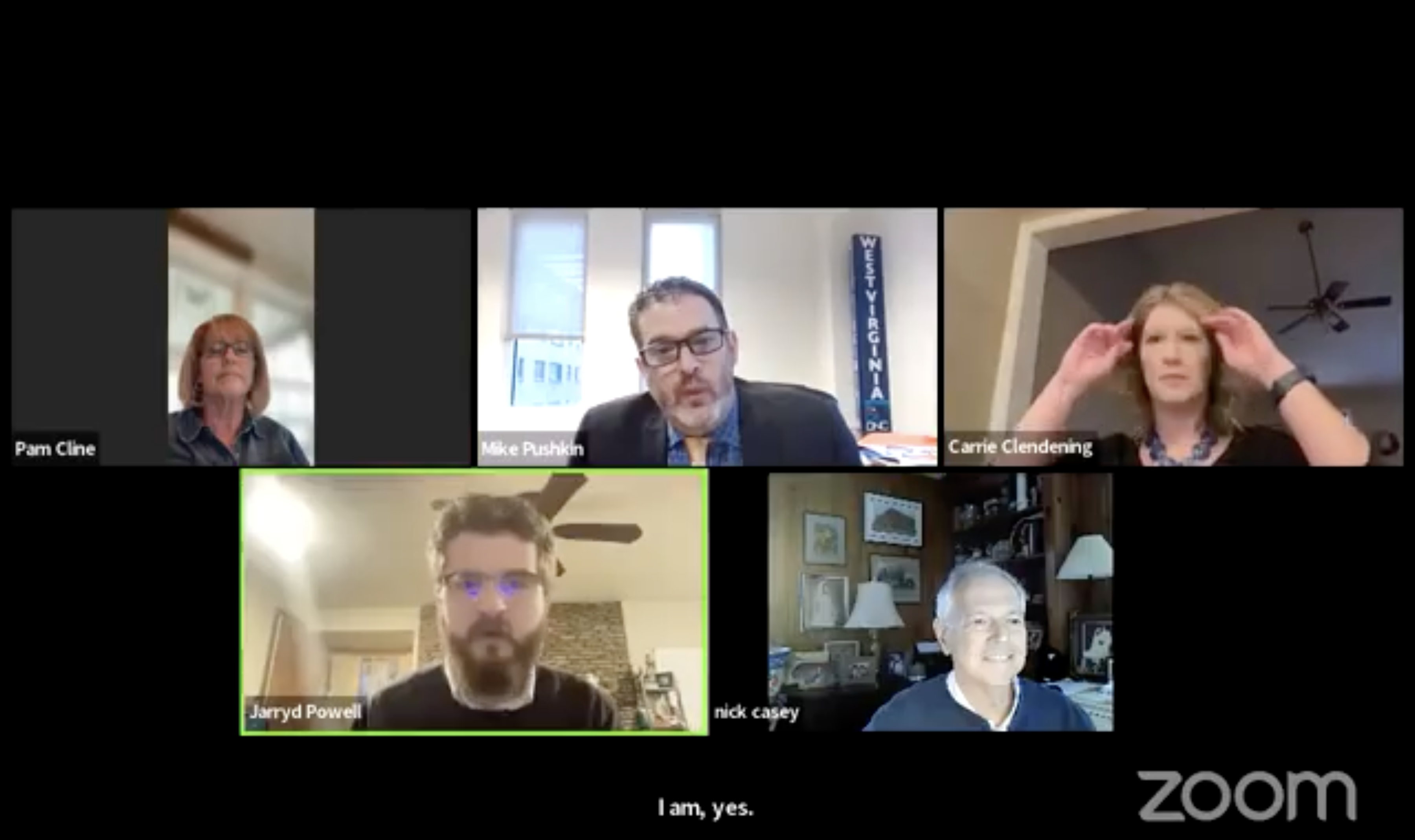
At 10:30 a.m. on June 4, 2024, Delegate Mike Pushkin walked into the Kanawha County Prosecutor's Office. He had requested the meeting to discuss what he described as a "possible criminal matter."
Around the conference table sat Adam Petry, Kenneth Bannon, and Kanawha County Prosecutor Debra Rusnak. Ryan Frankenberry, executive director of the West Virginia Democratic Party. Detective Ana Pile attended on orders from Kanawha County Sheriff Chief Deputy S.D. Snuffer.
It was Frankenberry who "did most of the explaining," laying out a case against Jacob Hively, president of the West Virginia Young Democrats.
According to Detective Pile's report, Frankenberry told prosecutors that Hively had "declared himself president" of the West Virginia Young Democrats, obtained a checkbook without the treasurer's authorization, and written checks to himself. He provided documents to support the claims. Frankenberry called it fraud.
In March 2024, Frankenberry met with a United Bank representative and obtained confidential banking records for the youth group's account. Frankenberry presented copies of six checks, numbered 151 through 156. Each was payable to Hively and signed "Jacob Hively, President."
The memo lines listed website hosting, a Young Democrats of America registration fee, printing, postage, and postcards. The total was $948.61.
At the close of the meeting, prosecutors directed that more information be obtained, including an interview with Hively, and ordered the case reviewed in its entirety to determine whether criminal charges were applicable.
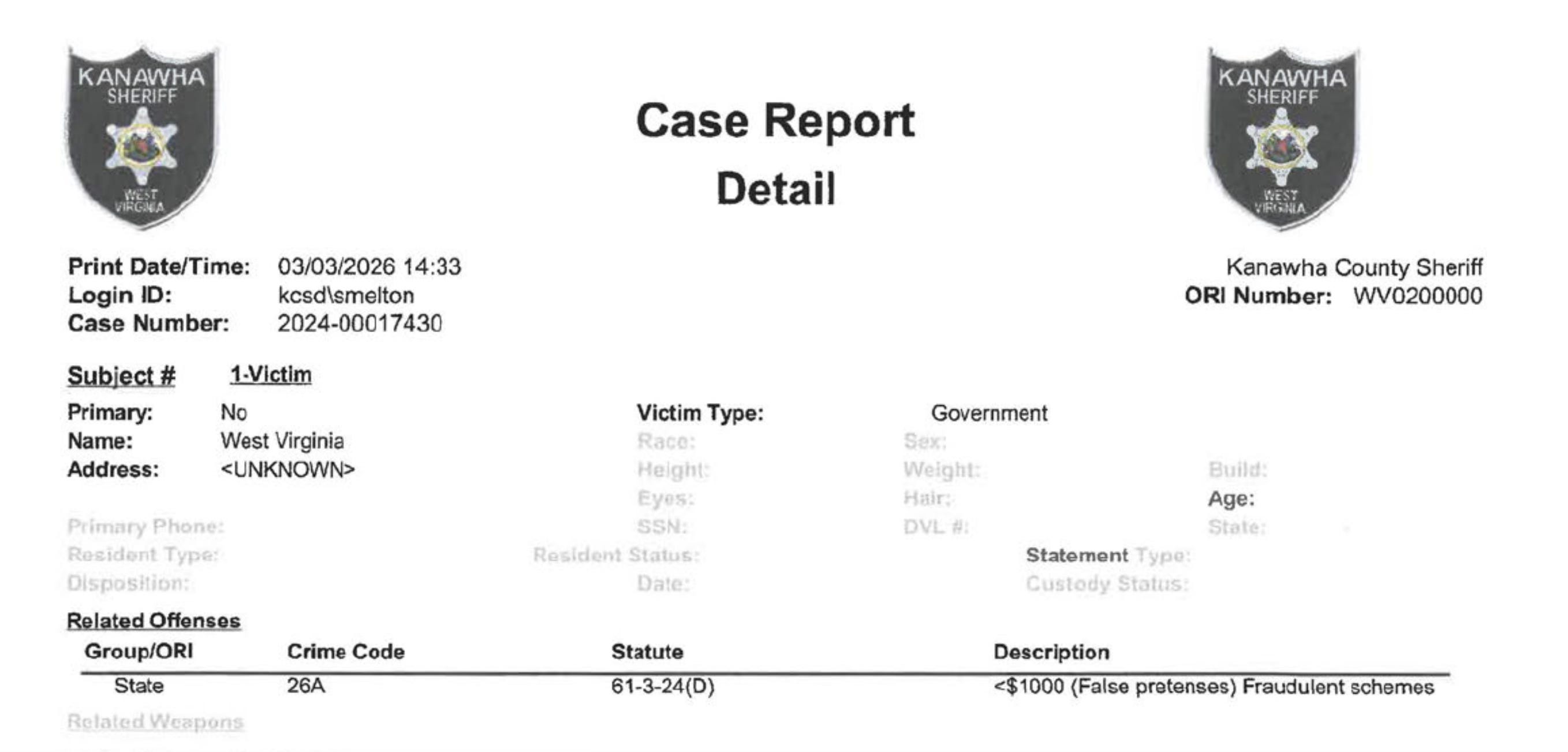
The Kanawha County Sheriff's Office opened a case. The listed victim was the State of West Virginia. The offense classification: fraudulent schemes, false pretenses under $1,000.
The criminal referral capped months of escalation. Since December 2023, Pushkin and Frankenberry had demanded Hively surrender the youth group's banking, social media, and other account credentials.
In February 2024, a state party Board of Appeals Zoom meeting formalized the threat of "legal action," authorizing Chair Pushkin to take legal measures should Hively refuse to comply.
In the weeks following the June 4th meeting, Detective Pile interviewed Hively and two other witnesses. Each contradicted the initial complaint.
Frankenberry claimed Hively had “declared himself president” and that “there is a procedure to follow” for an appointment to be valid.
Former WVYD president Lora Walker told Pile she appointed Hively on or about Oct. 1, 2022, under the organization’s bylaws. She texted Delegate Pushkin to inform him. Walker said she opposed the investigation and that Jacob “wouldn’t do anything criminally wrong.”
Frankenberry claimed Treasurer Chase Jarrell “never authorized Hively to obtain a checkbook or to have access to the bank account.”
Jarrell told Pile he had given Hively the United Bank mobile login in 2023 and said, “It wasn’t a secret” that Hively had a checkbook. He confirmed the purchases were legitimate, said Jacob “was diligent” about providing receipts, and stated he did not feel Jacob had committed a crime.
Frankenberry claimed Hively “was never added to the bank account.”
Hively showed Pile a United Bank email dated August 29, 2023, confirming his email address had been added. He produced text messages in which Jarrell referred to him as president, including one from June 15, 2023: “Let’s get your name on the account so you can get things going.”
He showed a message from November 2, 2023, in which Jarrell confirmed receipt of the checkbook, along with messages documenting each purchase and reimbursement as they occurred, which the detective described as the pair’s “checks and balances.”
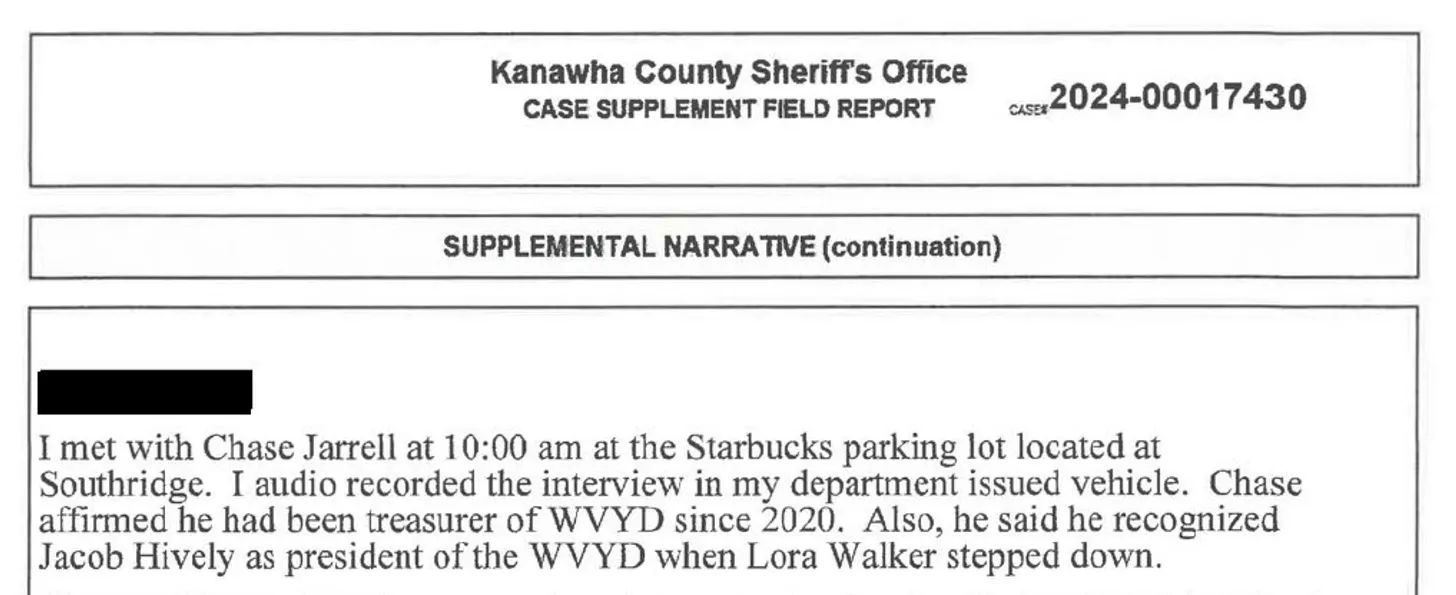
Pile examined the checks against the bank records. Her report states: “All purchases which were mentioned by the complainant appear to be purchases for legitimate items related to WVYD.”
On August 13, 2024, Detective Pile sent the completed case to the prosecutor’s office, where Rusnak, who had been present at the original meeting, held it for 18 months.
On February 20, 2026, a Freedom of Information Act request was filed with the Kanawha County Sheriff’s Office. Three days later, Pile emailed Rusnak and Petry:
Deb and/or Adam,The case regarding Jacob Hively allegedly embezzling money from the WV Democratic Party was sent down for review on August 13, 2024. The complainant was Mike Pushkin, Delegate. I have attached my narratives just for a quick refresher.I am emailing because we have received a FOIA request for the report, but I am showing it is still an open case.Can you have someone in the PAO review the matter to determine if there should be any criminal charges or not against Jacob Hively? Then, I need a letter or email declaring the decision.
The Prosecuting Attorney’s Office responded on March 13, after a phone call alerting them that a third request was incoming. It produced the declination email with the detective’s narrative removed.
For all other categories, including communications, arranging the June 4 meeting, materials presented by Frankenberry, and intake, routing, or case-status records covering the eighteen months the file was under review, the office stated it had no responsive records.
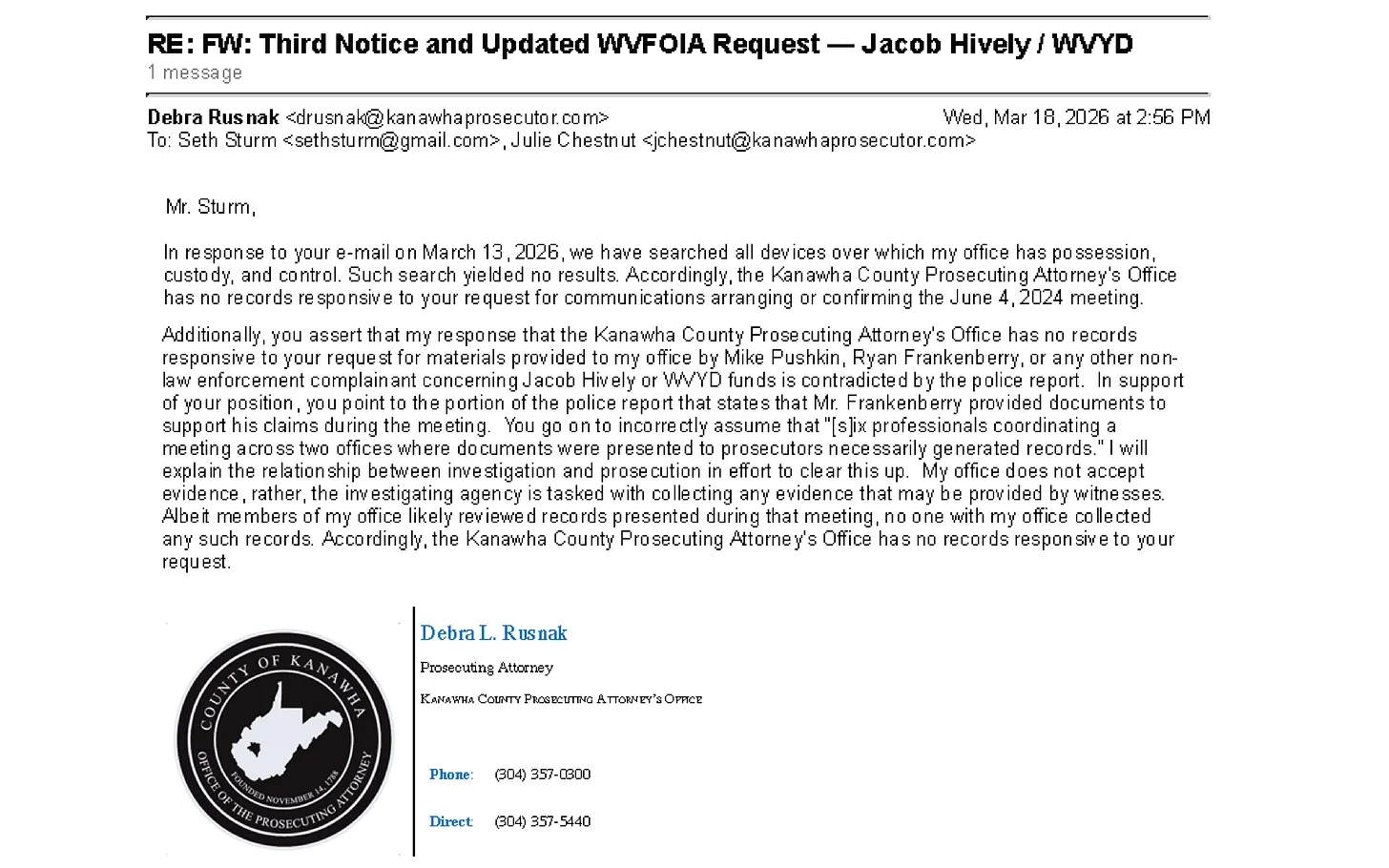
In a subsequent response, Prosecuting Attorney Rusnak confirmed that Frankenberry had provided documents during the meeting and that members of her office “likely reviewed” them.
She stated that her office “does not accept evidence” and that no one collected any records. She did not address the request for scheduling communications between Pushkin and Petry.
During the period when the case sat in prosecutorial limbo, Pushkin and Frankenberry secured operational control of the WVYD.
On January 23, 2025, Pushkin and Frankenberry filed Statements of Organization with the Secretary of State listing themselves as chairperson and treasurer of the West Virginia Young Democrats.
The DNC holds governance authority over the West Virginia Democratic Party. The West Virginia Democratic Party now maintains operational control of the West Virginia Young Democrats. The Young Democrats of America issued a charter to that group.
State-chartered chapters of the Young Democrats of America operate as separate entities, legally distinct from state parties. That separation exists because federal law requires it.
In 2002, Congress passed the Bipartisan Campaign Reform Act, known as McCain-Feingold, banning soft money contributions to political parties. Soft money is the unlimited, lightly regulated money that can flow from corporations, unions, and wealthy donors outside the federal contribution system.
The Young Democrats of America responded by separating from the Democratic National Committee and reorganizing as an independent political organization. The firewall between state parties and these independent organizations is what makes the fundraising architecture legal.
Federal regulators evaluate control through a multi-factor test that examines governance authority, overlapping officers, shared infrastructure, financing, and the overall relationship between entities.
The current filings for the West Virginia Young Democrats satisfy every one of those criteria.
Two entities that were separated to maintain a legal firewall are now connected through a state party's infrastructure. Whether that arrangement complies with campaign finance law is a question for federal regulators.
Read the first part of this story: Pretext
Does the West Virginia Democratic Party's control of the West Virginia Young Democrats violate federal campaign-finance law governing party committee affiliation?
Axioms
- A1 The Bipartisan Campaign Reform Act of 2002 bans soft money contributions to political parties. 1
- A2 The Young Democrats of America responded by separating from the DNC and reorganizing as an independent political organization. 1
- A3 A committee established, financed, maintained, or controlled by a party is affiliated with that party and subject to party committee restrictions. 1
- A4 Violations of federal campaign-finance law carry civil and criminal penalties.
Postulates
- P1 The West Virginia Young Democrats was a legally distinct, independently registered political organization. 1
- P2 Mike Pushkin is Chair of the West Virginia Democratic Party.
- P3 Ryan Frankenberry is Executive Director of the West Virginia Democratic Party.
- P4 On January 23, 2025, Pushkin and Frankenberry filed Statements of Organization listing themselves as Chairperson and Treasurer of the West Virginia Young Democrats. 1
- P5 The current WVYD filings list the state party's P.O. Box and email address. 1
- P6 Under Supreme Court precedent, a national political party has First Amendment associational rights, which give it governance authority over state parties. 1 2 3
- P7 The YDA issued a charter to an entity over which the state party has asserted governance authority and whose operations route through state party infrastructure. 1
Theorems
- T1 The WVYD now has overlapping officers with the WVDP (P2, P3, P4)
- T2 The WVYD now operates through state party infrastructure. (P5)
- T3 The WVYD meets the standard for a committee controlled by a party. (A2, P4, P5, T1, T2)
- T4 A controlled committee is subject to party soft-money restrictions under BCRA. (A1, A2, T3)
- T5 The DNC has governance authority over the West Virginia Democratic Party. (A5, P6)
- T6 By chartering an entity under state party control, the YDA has reconnected to the DNC through the state party structure. (A4, P6, P7, T3, T5)

Q.E.D.
For the first time since 2002, the Young Democrats of America is connected to the Democratic National Committee through official party channels.
Sources
- WEB congress.gov
- WEB yda.org
- WEB ecfr.gov
- PDF WVYD F-4 Statement of Organization — Hively/Jarrell (August 2023)
- PDF WVYD F-4 Statement of Organization — Pushkin/Frankenberry (January 23, 2025)
- PDF WVYD F-4 Statement of Organization — Dowler (January 2026)
- WEB supreme.justia.com
- WEB supreme.justia.com
- WEB supreme.justia.com
- WEB theintermountain.com